How Long Does It Take to Build a Website? Realistic 2026 Guide
From a business card site in a week to a store in 3 months - see realistic timelines, what most commonly delays projects, and how to speed yours up.

One of the first questions we hear from clients is always the same: "how long will it take?" It's a fair question - before you commit time, money, and energy to a new website, you want to know when you can expect it. The problem is that most answers you'll find online are vague. This article is different - you'll find realistic timelines, a list of the things that most commonly delay projects, and practical advice on how to speed up the whole process.
The Short Answer - How Long Does It Take to Build a Website?
It depends on the type of site. Here are realistic timelines for the most common project types:
| Type of website | Scope | Timeline |
|---|---|---|
| Business card site | 1-5 pages, contact form | 1-2 weeks |
| Company site with blog | 10-20 pages, CMS, basic SEO | 3-5 weeks |
| Corporate website | Multiple pages, integrations, multilingual | 5-10 weeks |
| Online store | Products, cart, payments, login | 6-14 weeks |
| Web application | Advanced features, user panel, API | 3-6 months |
Important caveat: these figures refer to the contractor's working time. The total project duration - from first contact to site launch - is usually 30-50% longer, because it includes time for client decisions, design approvals, and material delivery.
The Stages of Building a Website and How Long Each Takes
A website project is not one continuous process - it's several distinct stages, each with its own timeline and requirements.
Stage 1 - Consultation and Strategy (3-7 days)
Before a single pixel of design is created, several key questions need answering: who is the site aimed at, what is its goal, which features are essential and which aren't, and which technology fits the project best.
This stage is often skipped in cheap builds - and that's precisely why cheap websites often don't work. A solid strategy at the start saves weeks of revisions at the end.
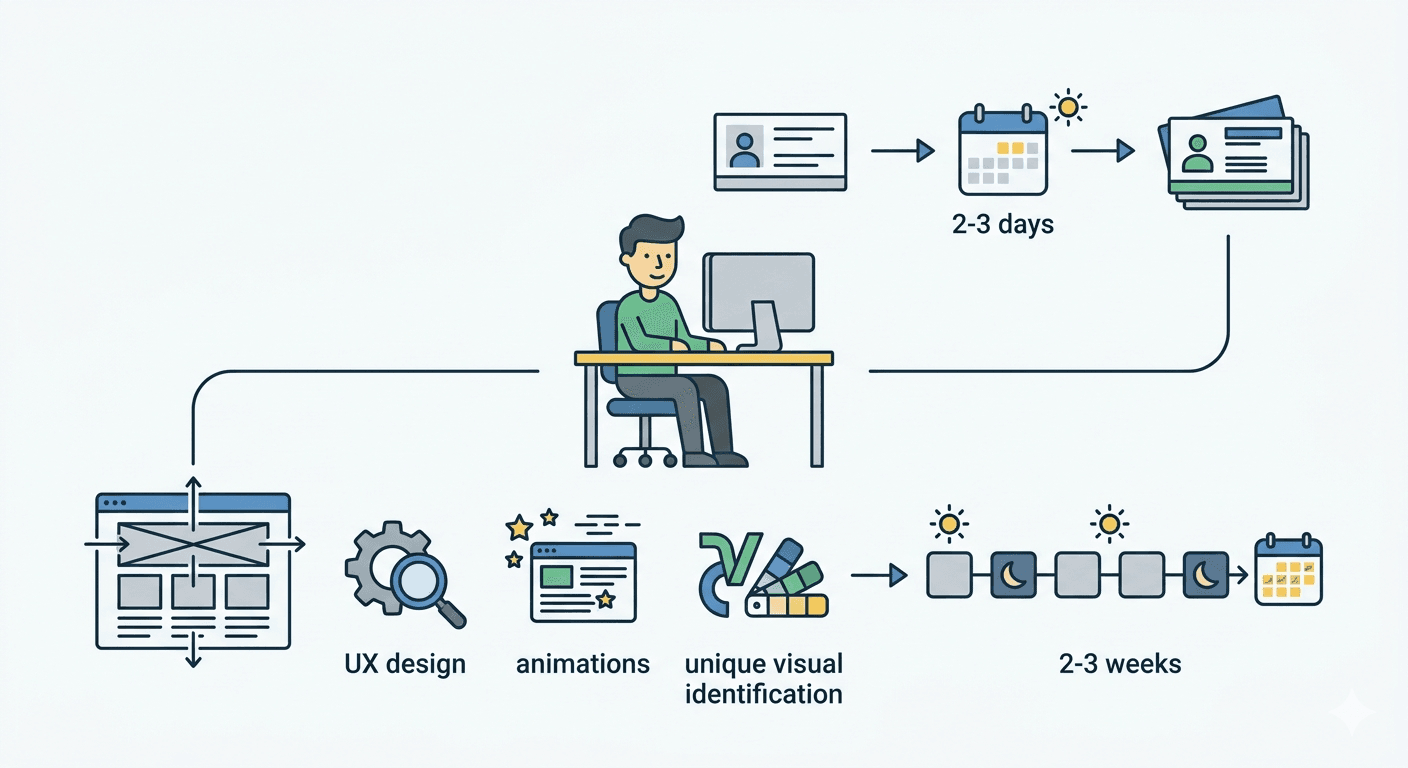
Stage 2 - Graphic Design and UX (1-3 weeks)
The designer creates wireframes - skeletal layouts showing content structure and navigation - followed by the full graphic design. Simple business card sites using ready-made templates can be ready in 2-3 days. A custom design with considered UX, animations, and a unique visual identity typically takes 2-3 weeks.
This is where the first delays usually appear - the client needs time to approve the design, submits feedback, revisions follow. Each round of changes adds 2-5 days.
Stage 3 - Content Preparation (1-4 weeks, running in parallel)
This is the stage clients most commonly underestimate. A website isn't just design - it's content. Photos, copy, service descriptions, team bios, case studies - all of this needs to be written and delivered by someone.
If the client delivers finished materials before the project starts, this stage doesn't extend the timeline. If materials are being created during the project, the project waits. In practice, delays caused by missing content are one of the two most common reasons projects run over time.
Stage 4 - Development and Implementation (1-6 weeks)
Development time depends directly on project complexity. A simple template-based site takes 3-5 working days. A site with custom design, CMS, and basic integrations takes 2-3 weeks. An online store with payments, product filtering, and an admin panel takes 4-8 weeks.
Stage 5 - Testing and Revisions (3-7 days)
Every site goes through testing before launch - responsiveness across devices, loading speed, form functionality, integration checks. This stage rarely ends without any fixes, so it's worth planning a buffer of at least a week.
Stage 6 - Server Deployment (1-2 days)
The technical process of launching the site on the target server, configuring the domain, SSL certificate, and basic analytics tools. A routine stage that, with smooth communication, takes one working day.
What Most Commonly Delays Website Projects?
Based on experience across dozens of projects, here are the things that most often extend timelines - and none of them have anything to do with the contractor's work.
Missing materials
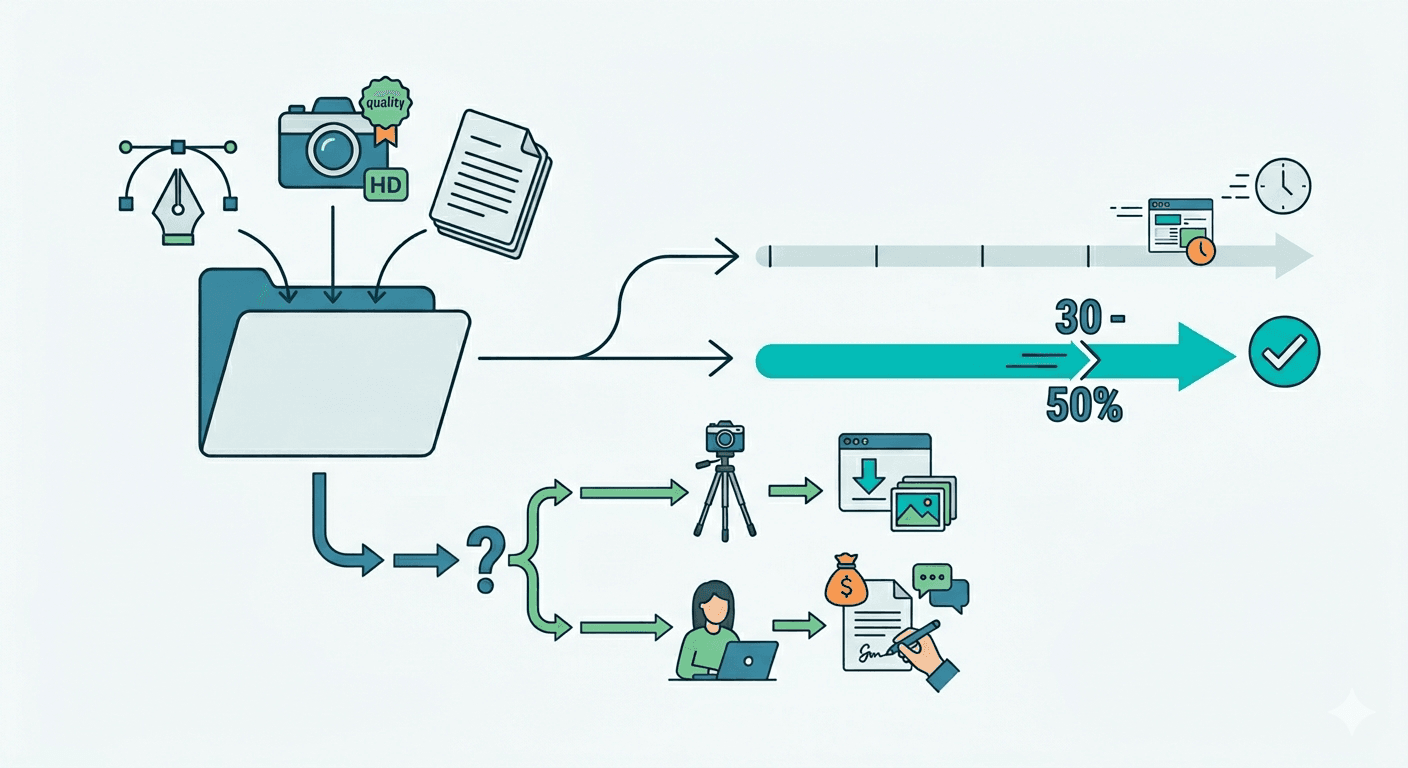
This is number one. The client approves the design, development begins - then it turns out the photos "will be ready next week," the copy "isn't finished yet," and the logo "only exists in a Word document." The project stops. Missing client materials account for the majority of delays in website projects.
The solution is simple: before signing a contract with a contractor, gather your logo in vector format, high-resolution photos, and finished copy for all pages in one place. If you don't have photos - decide whether you're doing a photoshoot or using stock images. If you don't have copy - decide whether you're writing it yourself or commissioning a copywriter. These decisions made before the project starts shorten the timeline by 30-50%.
Slow approvals
The designer sends the graphic design. The client needs time to "show their partner," "ask their co-founder," "think it over." A week passes, two weeks. Then 15 pieces of feedback arrive. The designer makes changes. Another round of waiting.
Smooth projects have agreed-upon approval rules from the start - who decides, within how many days, how many rounds of revisions are included. This isn't a question of bad intentions - it's a question of having no process.
Scope changes mid-project
"Could you also add a shop?" or "actually I'd like the site to be in English and Polish." Scope changes halfway through a project are the most expensive and slowest way to expand a site. Every major change is effectively a new project, requiring redesign, recoding, and retesting.
Choosing the wrong technology at the start
A site built on a tool that doesn't fit the requirements - too simple for complex needs, or too complicated to manage - generates problems that only surface after launch. Fixing them costs more time and money than making the right choice at the beginning.
How to Speed Up Your Website Project
A few things you can do before you even contact a contractor:
Prepare a brief - a short description of what you need, who the site is aimed at, which features are essential, and what your budget is. A contractor who receives a brief upfront quotes faster and more accurately, and the project starts without unnecessary back-and-forth.
Gather your materials first - logo, photos, copy. Even if not everything is ready, knowing what you have and what's missing allows for better timeline planning.
Decide who decides - establish upfront who in your company is the decision-maker for the project. One voice is always faster than five.
Don't change your mind mid-project - if you have doubts about scope or features, resolve them before the project starts. Changing your mind during development costs 3-5 times more than changing it before the start.
How Long Does It Take to Build a Website Yourself?
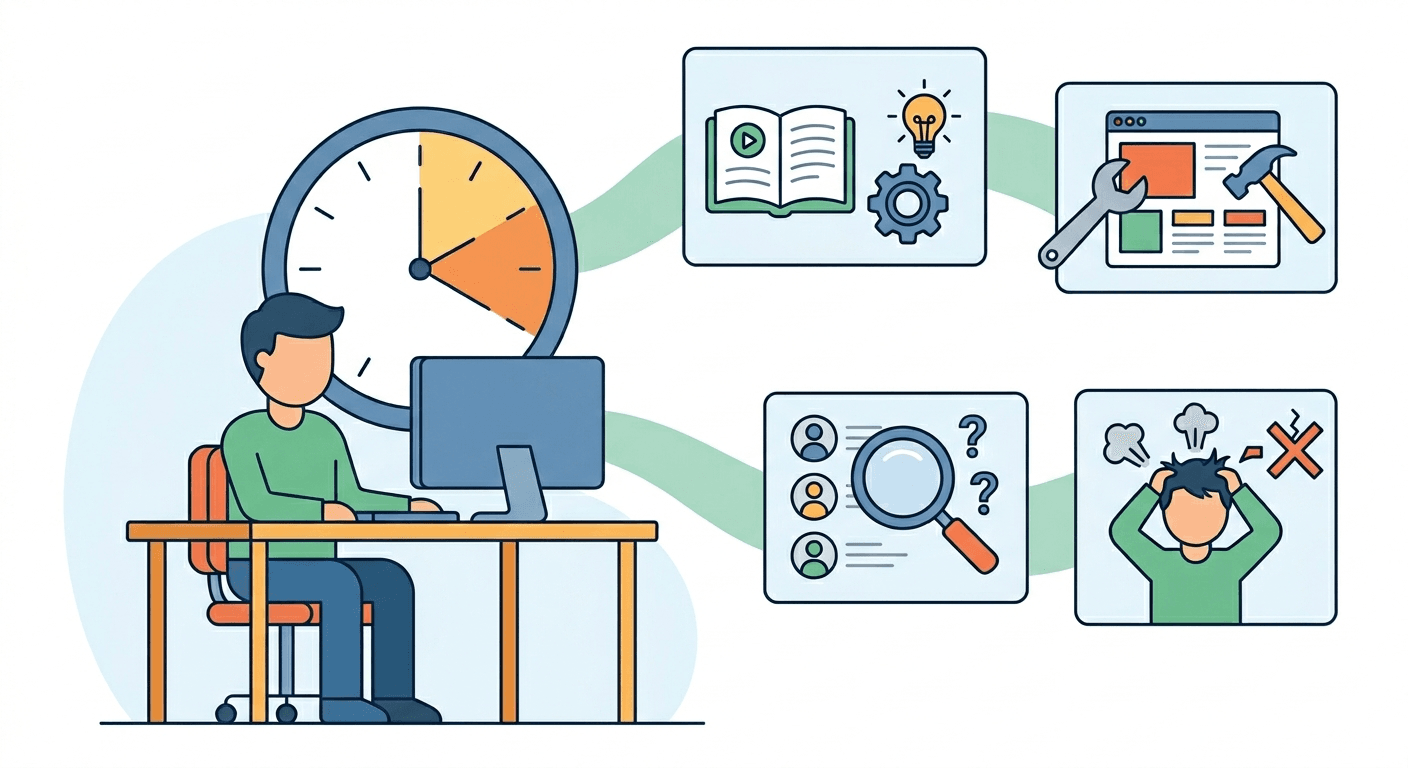
If you're considering building a site yourself on Wix, Squarespace, or WordPress with a ready-made theme - a realistic timeline for someone without experience is 2-6 weeks for something that looks decent. But time isn't the only cost. Add to that learning the tool, troubleshooting technical issues, searching forums for answers, and the frustration when something doesn't work the way it should.
More on whether it's worth building a site yourself in "Is It Worth Building a Website Yourself?".
FAQ - Common Questions About Website Build Times
How long does it take to build a simple business card website?
A simple business card site with 3-5 pages and a contact form takes 7-14 days with smooth collaboration. With a ready-made template and complete client materials provided upfront, you can get down to 5-7 working days.
Can a website be built in a week?
Yes, but only when several conditions are met simultaneously: a simple business card site, a ready-made template, complete materials delivered before the start, and fast approvals from the client. In practice, a one-week deadline is achievable for around 20-30% of projects.
Why did my previous project take so long?
The most common causes are missing materials, delayed approvals, or scope changes during the project. Less commonly - contractor underestimation or technical issues. If a project ran three times longer than planned - ask directly why. A good contractor can explain it.
Do I pay for waiting time when the project is stalled?
It depends on the contract. Most agencies set project timeframes, and if the project stalls because of the client for an extended period, they either reset the timeline with a new deadline or charge a reactivation fee. It's worth checking these terms before signing.
How do I know if a contractor will meet the deadline?
Ask for a detailed project schedule broken down by stages and deadlines for each. A good contractor should be able to give specific dates, not just "a few weeks." Also ask what happens if the deadline isn't met.
How long does it take to build an online store?
A simple store with a few dozen products, a standard cart, and a payment gateway is a minimum of 6-8 weeks. A store with hundreds of products, advanced filtering, warehouse integration, and custom design is 10-16 weeks or more. Online stores are significantly more complex than informational sites and require far more testing.
Does the size of the agency affect how long it takes?
Sometimes yes. A solo freelancer may work faster on simple projects but slower on complex ones. An agency with multiple specialists working in parallel can handle complex projects faster - but communication and coordination take time too. The key question isn't the size of the team but whether they have a clear process and a realistic schedule.
Summary
The time it takes to build a website depends on three things: project complexity, the quality of materials on the client side, and the efficiency of the decision-making process. The contractor controls only the first of these.
The best investment before a project starts is 2-3 hours gathering all materials, writing a brief, and establishing who in your company makes decisions. Projects that start with complete documentation finish faster, cost less, and deliver better results.
Want to know how long it would take to build your specific site? Book a free consultation - we'll get back to you with a quote and timeline within 48 hours.
Related articles

Website for Electricians and Plumbers - How to Get More Jobs from Google
What should a trade website include? How to rank in Google Maps and win more jobs from search? A practical guide with specific steps for electricians and plumbers.

Physiotherapy Website & SEO Guide: Get More Patients from Google
What does a physio clinic website actually need - and how do you rank on Google in 2026? A practical guide to SEO for physiotherapists.

Website or Google Maps Listing? What Local Businesses Actually Need in 2026
Limited budget, limited time - website or Google Business Profile first? An honest answer with real arguments, a clear priority order, and an action checklist.