How to Show Up in AI Search Results: GEO & AEO Guide for 2026
If you're not cited in ChatGPT or Perplexity, you're invisible to millions of potential clients. Here's exactly what to do about it - no fluff, just tactics.
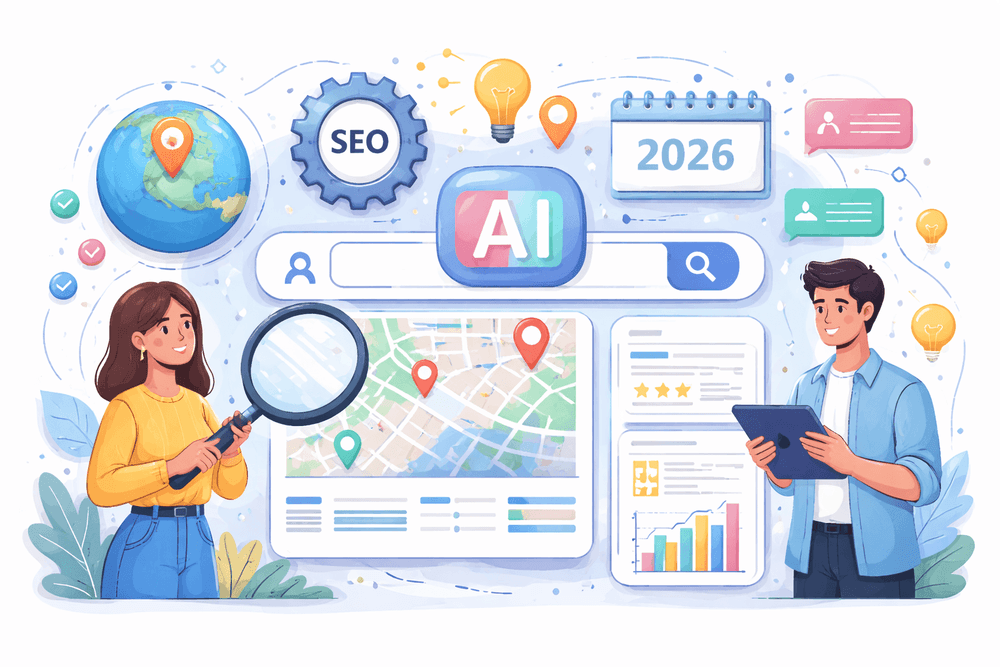
How to Show Up in AI Search Results: A Practical GEO & AEO Guide for 2026
When someone asks a question in ChatGPT, Perplexity, or Google AI Overviews, they don't get a list of links to click. They get a synthesized answer - with a handful of cited sources. If your website isn't one of those sources, you simply don't exist for that user.
This is the new reality of search in 2026. Google AI Overviews now appear in 30-40% of all searches. ChatGPT serves 800 million weekly users. Perplexity processes 780 million monthly queries. These aren't niche tools - they're mainstream channels your potential clients use every day.
This guide explains how AI search engines work, what GEO and AEO mean, and exactly what to do to make your business show up in AI-generated answers.
How AI "Searches" - and Why It's Different From Google
To optimize for AI, you first need to understand how different systems retrieve information. They work in two fundamentally different ways:
Real-time retrieval systems (Perplexity, Google AI Overviews, ChatGPT with search enabled): these scan the web at the moment a query is asked, retrieve relevant pages, and synthesize an answer - citing sources. They work similarly to Google, but instead of showing a list of links, they write a complete response.

Training data systems (ChatGPT without search, Claude, Gemini in offline mode): these answer based on knowledge encoded during model training. To appear in them, your content needed to be published, indexed, and recognized as authoritative before training occurred - and models are retrained regularly, so publishing good content now builds future citation probability.
Practical implication: optimizing for Perplexity and Google AI Overviews is very similar to traditional SEO. Optimizing for ChatGPT and Claude is about long-term authority building through consistent, high-quality content publication.
What Is GEO and AEO?
Two terms have emerged that are worth understanding:
GEO (Generative Engine Optimization) - the practice of optimizing content to be cited by AI systems generating answers. The term was formalized by researchers from Princeton University, Georgia Tech, the Allen Institute for AI, and IIT Delhi in 2023. The goal: become a cited source in an AI-generated answer, not just rank in traditional results.
AEO (Answer Engine Optimization) - optimizing content so AI can easily extract and present it as a direct answer to a question. An older term originally associated with voice search, now used interchangeably with GEO.
Critical point: GEO and AEO don't replace SEO. They extend it. Google itself confirms that traditional SEO remains the primary method for optimization - AI Overviews use the same signals as organic results. Ahrefs research shows that 76.1% of URLs cited in AI Overviews also rank in Google's top 10.
In other words: strong SEO is the foundation for AI visibility. GEO is an additional layer on top.
How Each AI Platform Selects Sources
Each platform has its own preferences - knowing them helps you prioritize:
Google AI Overviews The strongest correlation with traditional Google rankings of any AI platform. If you rank in the top 10 organically, you have a 33% chance of appearing in an AI Overview for that query. Strong E-E-A-T signals (Experience, Expertise, Authoritativeness, Trustworthiness) are critical. Structured content with clear heading hierarchy and FAQ sections is favored.
Perplexity The fastest-growing AI search platform. Averages 6.61 citations per response. Heavily favors YouTube, Reddit, and LinkedIn. Prefers current, multi-format content with cited data. A strong option for B2B - it prioritizes niche expert sources over large generalist publications.
ChatGPT with search An interesting pattern: approximately 90% of cited pages rank at position 21+ in Google - meaning ChatGPT reaches for sources that traditional SEO would overlook, if they're sufficiently topically relevant. 43.2% of pages ranking #1 in Google are cited by ChatGPT - but 28.3% of ChatGPT-cited pages have zero Google visibility. Topical authority and content quality matter more here than raw ranking position.
Gemini Heavily cites Reddit and Medium. Rigorous fact-checking - data without cited sources is less likely to be referenced. Structured data (schema markup) helps significantly.
Microsoft Copilot 87% of SearchGPT citations match Bing's top results. If you rank well in Bing, you're more likely to be cited by Copilot. Make sure your site is indexed in Bing Webmaster Tools.
What to Actually Do - Actionable Checklist
1. Answer the Question Immediately - Don't Build Up to It
AI scans the first 200 words of an article to determine relevance. Pages with an "answer capsule" at the top have 40% higher citation rates than those that build toward an answer gradually.
Instead of starting with: "In this article, we'll explore what..." - open with the direct answer: "A professional website for a small business costs between $2,000 and $10,000, depending on..."
2. Structure Content for AI Extraction
AI extracts fragments, not full articles. Each section should be understandable without reading the preceding ones. Avoid "as mentioned above" - AI may only pull that fragment.
What performs best according to current data (Wix, March 2026):
- listicles (21.9% of citations in AI Mode, ChatGPT, and Perplexity)
- articles and guides (16.7%)
- product/service pages (13.7%)
Specific elements AI favors citing:
- H2/H3 headers phrased as questions
- FAQ sections with direct answers
- comparison tables
- definitions at the start of sections
- numbered step-by-step lists
3. Use Data With Cited Sources
AI prefers content with verifiable data. "According to Ahrefs' 2025 study, 76% of pages..." is cited more often than "experts say...". Always attribute statistics to a source with a date.
Your own data is particularly valuable - original research, client case studies, before/after results. Content with unique data gets cited by AI more readily than syntheses of publicly available information.
4. Implement Schema Markup
Schema markup is code that tells AI what your page contains. Most important types:
FAQPage- for question-and-answer sectionsHowTo- for step-by-step guidesArticlewith author and publication dateLocalBusiness- for local service businessesBreadcrumbList- for clear site structure
Google confirms schema isn't required to appear in AI Overviews - but it helps AI better understand your content's context and purpose.
5. Allow AI Bots to Crawl Your Site
Check your robots.txt file. ChatGPT uses GPTBot, Perplexity uses PerplexityBot. If these bots are blocked - you don't exist to those platforms. Most sites don't block them by default, but it's worth verifying, especially if your site has gone through redesigns.
6. Build Presence on Platforms AI Cites
Perplexity and Gemini frequently cite: Reddit, YouTube, LinkedIn, G2, Medium. This means your presence on these platforms directly increases your chances of appearing in AI-generated answers.
Concrete actions:
- Publish expert articles on LinkedIn (articles, not just posts)
- Answer questions on relevant Reddit communities genuinely
- Create YouTube content - Perplexity especially favors video sources
- Get listed on G2 or Clutch if you're a B2B business
7. Strengthen E-E-A-T Signals
AI prefers content with clearly identified authors and their expertise. In practice:
- sign articles with a full name, not just "Editorial Team"
- add a short author bio to every blog post
- link to the author's LinkedIn profile
- mention certifications, years of experience, and relevant client results

8. Update Content Regularly
AI prefers fresh content - especially Perplexity and Google AI Overviews, which search in real time. An article published in 2023 with no updates has less chance of citation than one with a 2026 update date. Add a "Last updated" date to every article and refresh key content annually.
How to Measure AI Visibility
This is the hardest part - there's no "Google Search Console for ChatGPT." But there are workable methods:
Manual audit (free, time-intensive): Open ChatGPT, Perplexity, and Google in incognito mode. Enter 10-15 queries relevant to your business. Check whether your brand or website is cited. Record results in a spreadsheet. Repeat monthly.
Google Search Console: Traffic from AI Overviews is included in the standard "Web" search report - it isn't separately filterable. Traffic growth without ranking improvements may signal growing AI Overview citations.
Paid tools: Otterly.ai, Profound, SE Ranking - offer monitoring of AI search mentions. For small businesses in the early stages of building visibility, this is an unnecessary cost. Start with manual audits.
Branded search growth: An increase in searches for your company name in Google is an indirect signal that AI is citing you and building brand awareness.
SEO vs. GEO: What Should You Focus On?
The honest answer for 2026: both, but SEO first.
Without solid SEO foundations - technical health, speed, E-E-A-T, backlinks - GEO won't work. Google AI Overviews use the same signals as organic results.
The good news: most SEO work (quality content, structure, speed, structured data) directly translates to AI visibility. It's not double the work - it's smarter work.
Recommended effort distribution in 2026:
- 50% - traditional SEO (technical, content, links)
- 30% - AI-specific content optimization (structure, FAQ, data)
- 20% - presence on platforms cited by AI (LinkedIn, YouTube, industry directories)
Frequently Asked Questions
Does GEO replace SEO? No. GEO is an additional layer on top of SEO. Google confirms that traditional SEO remains the primary optimization method. 76% of URLs cited in Google AI Overviews also rank in the organic top 10.
How long does it take to appear in AI results? For real-time retrieval systems (Perplexity, Google AI Overviews) - initial effects appear within 4-8 weeks of implementing changes. For training data systems (ChatGPT without search) - long-term authority building, effects visible after several months.
Do I need to rank #1 on Google to appear in AI results? For Google AI Overviews - top 10 significantly increases your chances. For ChatGPT - no, 90% of cited pages rank at position 21+ in Google. Topical relevance and content quality matter more than raw ranking position.
Can a small business compete with large companies in AI search? Yes - especially for niche and local searches. ChatGPT and Perplexity reach for expert niche sources, not just the largest domains. Good, detailed content with a unique perspective has a realistic chance of being cited even with low domain authority.
How do I check if I'm being cited by AI? The simplest method: open ChatGPT and Perplexity in incognito mode, ask questions relevant to your business, and check whether you appear in the cited sources. Repeat monthly to track progress.
What's the difference between GEO and AEO? GEO (Generative Engine Optimization) specifically targets AI systems that generate synthesized responses - ChatGPT, Perplexity, Gemini. AEO (Answer Engine Optimization) is a broader term originally from voice search, now largely used interchangeably with GEO. Both describe the same strategic goal: being cited in AI-generated answers.
Want your website to be visible in both Google and AI search results? Explore our services - we build websites optimized for traditional SEO and GEO standards from day one.
Related articles
Google Business Profile - How to Set Up and Optimise Step by Step (2026)
Complete guide to Google Business Profile - from creating your account through every section to a monthly routine that improves your Google Maps ranking.
Why Does My Competitor Rank Higher on Google Maps? 7 Reasons (and How to Fix Them)
Your competitor shows up in Google Maps and you don't? Here are 7 specific reasons why - and exactly what to do to fix each one.
Local SEO – how to rank your business in Google Maps
Learn how to effectively use local SEO to position your business in Google Maps. Practical tips and strategies to increase visibility.