Physiotherapy Website & SEO Guide: Get More Patients from Google
What does a physio clinic website actually need - and how do you rank on Google in 2026? A practical guide to SEO for physiotherapists.

When someone wakes up with back pain, they don't ask their neighbour for a recommendation - they type "physiotherapist near me" into Google and book an appointment with whoever shows up first. If your clinic isn't there, you don't exist for that person. This guide covers what a physiotherapy website needs to look like and what it takes to rank on Google in 2026.
Why Physiotherapists Lose Patients Through Poor Online Visibility
Word-of-mouth referrals used to be enough to keep a full schedule. That's no longer the case. Today, most patients - especially those under 50 - start their search for a physiotherapist on Google. They type things like:
- "physiotherapist near me"
- "back pain physio [city]"
- "knee rehabilitation clinic"
- "sports injury physio"
- "dry needling near me"
If your website doesn't appear for these searches, you're losing patients to competitors - even if you're the better clinician.
What a Physiotherapy Website Needs to Do
Your website has two jobs at once: convince the patient they're in good hands, and be understood by Google. These are not competing goals - a website that genuinely serves patients also performs well in search engines.

Homepage - the first 3 seconds decide everything
When a potential patient lands on your homepage, they have one question: "Can this clinic help me?" The answer needs to be immediate. Your homepage should include:
- A clear headline stating what you do and where you're based (e.g. "Physiotherapy & Rehabilitation - Bristol City Centre")
- A brief summary of your specialisations - spine, knees, post-surgery rehab, sports physio, etc.
- Photos of your clinic and yourself - anonymity kills trust, especially in healthcare
- A visible "Book Appointment" button above the fold, before any scrolling
- Your phone number at the top of the page - many patients prefer to call
Service pages - one topic, one page
The biggest SEO mistake physiotherapy clinics make is listing all services on a single page. From a search engine perspective, this is wasted potential.
Each service deserves its own dedicated page:
- Back and spine physiotherapy
- Sports injury rehabilitation
- Knee physiotherapy
- Manual therapy
- Dry needling
- Pelvic floor physiotherapy
- Post-operative rehabilitation
Each page should describe: what the treatment involves, who it helps, what a session looks like, how long recovery takes, and what the cost is. A patient searching for help with knee pain lands exactly where they were looking - and is far more likely to book.
About page - this is where trust is built
In healthcare, trust is currency. Patients want to know who they'll be working with. Your about page should include:
- A professional but natural photo taken in your clinic
- Your qualifications and certifications
- Your specialisations and experience
- A short personal story - why did you choose physiotherapy?
- Mention of ongoing professional development (courses, training)
You don't need to write an essay. A few honest paragraphs work better than marketing copy.
Blog - your long-term organic traffic engine
A blog is the most powerful SEO tool a physiotherapist has over the long term. Patients research their condition before deciding to book. If your article answers their question, they land on your website - and often convert into patients.
Topics worth writing about:
- "Lower back pain - when should you see a physio?"
- "ACL reconstruction rehabilitation - what does recovery actually look like?"
- "5 exercises for neck pain from sitting at a desk all day"
- "What is dry needling and does it hurt?"
- "How many physio sessions does sciatica usually take?"
These are questions your patients type into Google every single day.
Physiotherapy SEO - what actually moves the needle in 2026
1. Google Business Profile - your non-negotiable starting point
Before thinking about website rankings, make sure your Google Business Profile is complete and optimised. This is what drives your appearance in Google Maps and the local "3-pack" - the three businesses shown above organic results for local searches.
What you need to do:
- Primary category: set it to "Physiotherapist" or "Physical Therapy Clinic"
- Secondary categories: add "Sports Medicine Clinic", "Rehabilitation Centre" as appropriate
- Description: write it the way patients speak, not clinicians. Instead of "We apply manual and instrumental soft tissue mobilisation techniques" - write "We help with back pain, knee injuries, and shoulder problems using hands-on and modern physiotherapy methods"
- Services: fill in your complete list of treatments - Google uses these to match your profile to relevant searches
- Photos: upload at least 10-15 photos of your clinic, equipment, and yourself. Profiles with photos receive significantly more engagement
- Opening hours: always current, including bank holidays
- Respond to every review: positive and negative alike
2. Patient reviews - the most powerful ranking factor you control
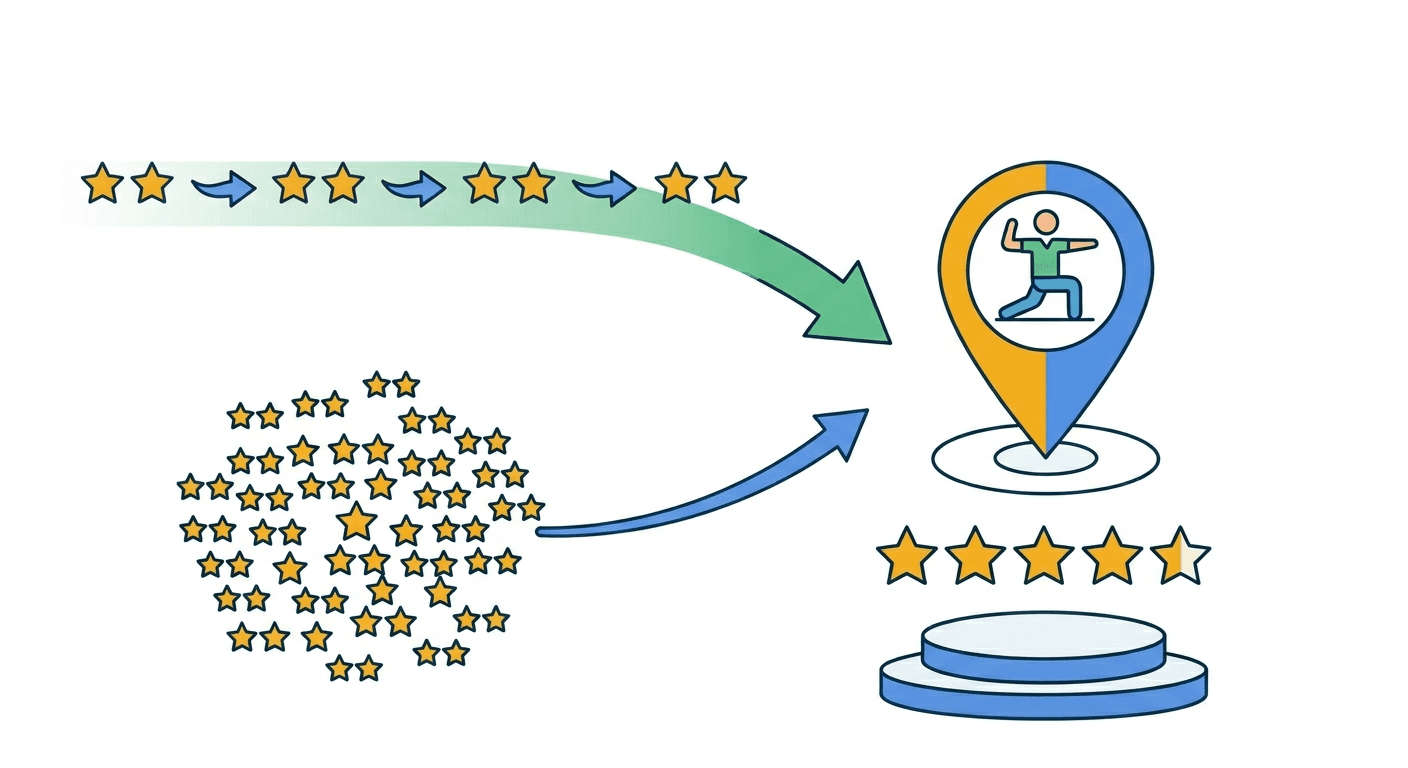
Physiotherapy clinics with top Google Maps positions typically hold 4.7+ stars and receive reviews consistently. Google's algorithm rewards not just review quantity, but recency - two reviews per month is a stronger signal than twenty reviews in one month and then nothing.
How to ask for reviews naturally: wait until a patient shows clear progress. That's the moment they're genuinely happy and willing to share. You might say: "I'm really pleased with the progress you've made. If you'd be willing to share your experience on Google, it genuinely helps other patients find the clinic." Follow this up with a text or email containing a direct link to your Google review form.
3. Keywords - think like a patient, not a clinician
Patients don't search for "soft tissue mobilisation therapy". They search for "shoulder pain physio" or "knee rehab clinic Birmingham". Your website needs to use the language your patients actually use.
The most important places to include keywords:
- Page title tag - e.g. "Physiotherapy Bristol - Spine & Sports Rehab Clinic | [Your Name]"
- H1 heading on each page
- First 100 words of the body content
- Image alt text
- URL - e.g.
/sports-physiotherapy-bristolrather than/services
4. Local keywords - don't compete nationally
You don't need to rank nationally. Your patients are searching for a clinic in their city, their neighbourhood, sometimes their street. Focus on:
- "physiotherapist [city]"
- "physio [neighbourhood]"
- "sports physio [city]"
- "back pain physio [city]"
The more local and specific the keyword, the less competition and higher conversion rate - because someone typing "physio Clifton Bristol" is ready to book, not just browsing.
5. Mobile speed and performance - the technical minimum
More than 70% of patients search for a physiotherapist on their phone. If your site loads slowly or looks broken on a smartphone, you lose both patients and ranking positions.
The minimum technical standard:
- Page load time under 3 seconds
- Full responsiveness (adapts correctly to phone screens)
- Readable font without zooming
- Buttons large enough to tap with a thumb
- Booking form that works on mobile
6. Expert content - E-E-A-T in healthcare
Google applies stricter standards to health websites, which fall under the "Your Money or Your Life" category. To build authority (E-E-A-T: Experience, Expertise, Authoritativeness, Trustworthiness):
- Sign all content with your full name and credentials
- Display your qualifications and certifications on the About page
- Link to credible sources (research papers, chartered physiotherapy bodies)
- Keep content updated - outdated medical information hurts rankings
7. Condition-specific pages - a strategy that compounds
Rather than one generic "Physiotherapy Services" page, build dedicated pages around specific conditions and search intents. Examples:
- "Knee pain when going down stairs - causes and physiotherapy treatment"
- "Frozen shoulder: what it is and how physio can help"
- "Sciatica physiotherapy - what to expect"
These long-tail pages are easier to rank, attract patients who are further along in their decision, and naturally link back to your core service pages.
How long does physiotherapy SEO take?
Honest answer: first results typically appear within 3-4 months, stable rankings within 6-12 months. SEO is a long-term investment, but its effects are compounding - unlike paid ads, which stop the moment you stop paying.
For comparison: Google Ads can bring patients within days, but the cost per click for "physiotherapist [city]" keywords is often several pounds per click. A patient acquired through organic search costs nothing once the investment in good content has been made.
Where to start - a practical action plan
If you're building your online presence from scratch, here's the sequence that makes sense:
- Set up or fully optimise your Google Business Profile - this delivers results fastest
- Get your first reviews - ask 10 existing patients to leave a Google review
- Build or redesign your website - with separate pages for each service
- Start a blog - minimum one article per month, focused on patient questions
- Monitor results - Google Search Console is free and shows exactly which searches are finding you
Summary
A well-built website and a considered SEO strategy aren't luxuries for a physiotherapy clinic - they're tools of the trade, as important as a treatment table or an ultrasound machine. Patients search for help on Google and book appointments online. The question isn't whether it's worth being visible - it's how many patients you're losing each month by not being there.
If you'd like to discuss how your clinic's website could look and what it would take to rank higher in Google - book a free consultation.
Written by SN Solutions - we build websites and handle SEO for local businesses and specialists, helping clinics, practices, and service providers appear where their clients are already looking.
Related articles

Website for Electricians and Plumbers - How to Get More Jobs from Google
What should a trade website include? How to rank in Google Maps and win more jobs from search? A practical guide with specific steps for electricians and plumbers.

Will AI Replace Web Developers? What 2026 Data Shows
AI website builder or web agency - which do you actually need? Here's what 2026 data says about AI in web development and when it's worth hiring a professional.

Website or Google Maps Listing? What Local Businesses Actually Need in 2026
Limited budget, limited time - website or Google Business Profile first? An honest answer with real arguments, a clear priority order, and an action checklist.