Website or Google Maps Listing? What Local Businesses Actually Need in 2026
Limited budget, limited time - website or Google Business Profile first? An honest answer with real arguments, a clear priority order, and an action checklist.
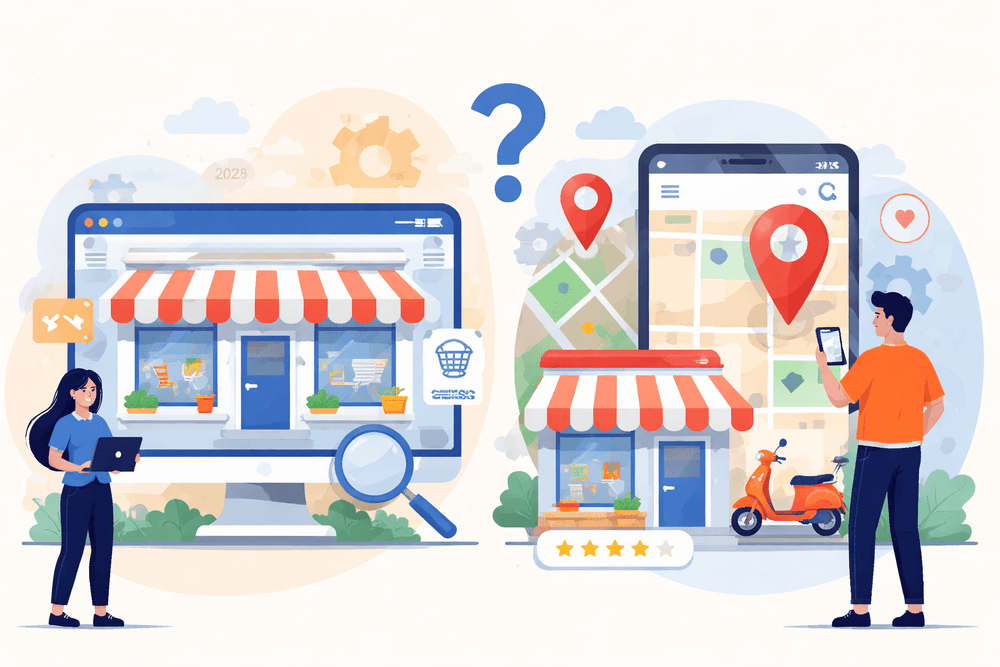
This question comes up constantly in conversations with small business owners. A hairdresser in Kraków, a mechanic in Gdańsk, a dental clinic in Wrocław - at some point, everyone faces the same dilemma: I have a limited budget and limited time, so where do I invest first?
The answer is less obvious than it might seem. And it depends on a few factors that rarely get discussed honestly.
What Each Tool Actually Is
Before we compare them, it's worth making sure we're talking about the same things.
A Google Business Profile (formerly Google My Business) is a free listing that appears in Google Maps and in search results when someone looks for a business by name or by category in a specific location. It shows your name, address, phone number, opening hours, photos, and customer reviews.
A website is your own space online - full control over content, design, your offer, pricing, and everything you want to say to potential customers.
Each tool plays a different role. And that's exactly where the nuance lies.
Where Will a Customer Find You First?
Picture two scenarios:
Scenario A. A woman in Kraków is looking for a hairdresser. She types into Google: hairdresser Kraków Podgórze. What does she see? At the top of the page, a "Local Pack" appears - a map with three businesses and their ratings. To get into that spot, you need above all a well-optimised Google Business Profile.
Scenario B. The same person heard about your salon from a friend. She types in your salon's name. She lands on your website. She checks the price list, looks through photos of finished work, reads about your team. She decides whether to call.
In scenario A, the Google listing is the key. In scenario B - the website. In reality, both scenarios happen every day, often with the same person.
What a Google Listing Gives You That a Website Doesn't
Immediate local visibility
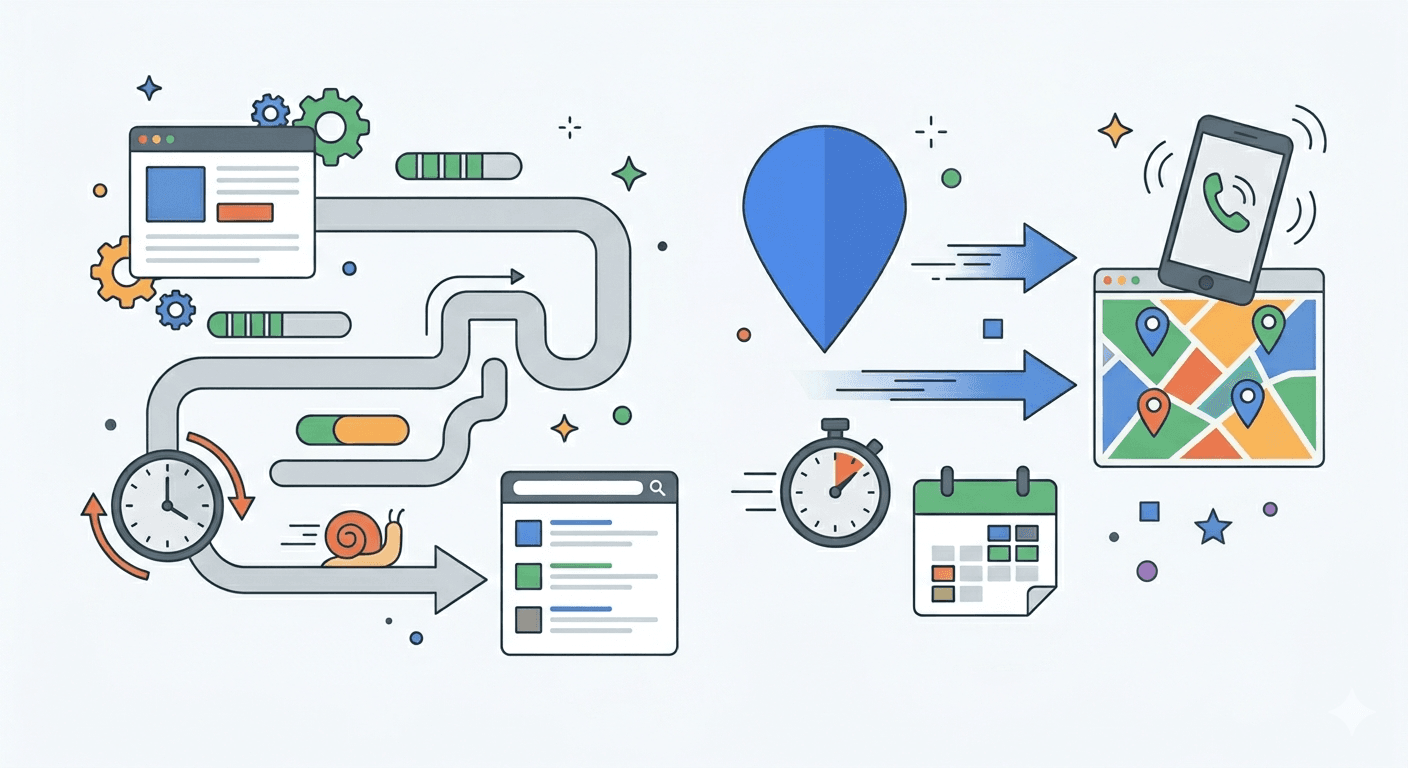
A Google Business Profile is the fastest route to appearing in local search results. A website needs months of SEO work to climb to the first page of results. A well-filled-out listing can start generating phone calls within a few weeks.
The decision happens on the spot
When a customer sees your listing in Google Maps, they have everything they need to make a decision: star rating, reviews, opening hours, phone number, location. One tap - and they call. No visiting a website required.
Research consistently shows that the vast majority of local searches end in action - a phone call or a visit - within 24 hours. The Google listing is designed precisely for this purpose.
Reviews build trust faster than anything else
Your Google listing accumulates customer ratings that you can't moderate or delete. This actually works in your favour - because the same reviews that help you build credibility are perceived as authentic by potential customers precisely because you don't have full control over them.
The algorithm uses three factors
Google decides who to show in the Local Pack based on three things: distance from the user, relevance of the profile to the search query, and prominence of the business (measured by the number and quality of reviews and how actively the profile is maintained). Your website doesn't directly influence these - your listing does.
What a Website Gives You That a Google Listing Doesn't
Full control over your message
A Google Business Profile is a form you fill out - you have set fields and set options. A website is your space where you can say exactly what you want, in exactly the way you want. A detailed service offering, a price list, your company story, photos of completed work, certifications - all of this is only possible on a website.
Conversion during the research phase
A customer who doesn't know you yet and is comparing several businesses - that customer will visit your website. They want to see more than five photos and a 200-character description. They want to read about your approach, see a portfolio, check prices. A website gives them what they need to make a decision.
Visibility for non-local search queries
Phrases like "how to choose a good hairdresser", "how much does keratin hair straightening cost", or "what to ask a beautician before a treatment" - these are searches that a Google listing will never capture, because there's no content there to match them. A website with a blog can.
The foundation for all other marketing
Google Ads, Facebook Ads, links from directories, social media posts - all of them lead to a website. A Google listing isn't a landing destination for paid traffic. A website is.
Stability independent of Google's algorithm changes
The local algorithm changes regularly. Profiles that spent years in the top 3 can drop off the first page after a single update. A well-built website with solid organic SEO is significantly more resistant to those fluctuations.
One analogy that captures it well: a Google Business Profile without a website is like a house without foundations - it can stand, but the first serious algorithm update might knock it over.
How This Is Changing in 2026 - The AI Factor
In 2026, a new player enters the equation: AI-generated search.
Google SGE, ChatGPT Search, Perplexity - these tools increasingly answer user questions without sending them to individual websites. Instead of a list of results, they show a ready answer: "The highest-rated hair salons in your area are X, Y, and Z."
Where do they get that data? From Google Business Profiles - but also from content on websites. Businesses that have a well-described offer, reviews, and content on their site have a better chance of appearing in those answers.
This means that over the next two to three years, content on your website will have a direct impact on whether you appear in AI search results - not just in classic Google. A listing alone won't guarantee that.
So Which Should You Choose - Listing or Website?
The honest answer: both, but start with the Google listing if you're just getting started.
Here's why that order makes sense:
A Google Business Profile is free, can be set up in an hour, and starts working relatively quickly. It gives you immediate local visibility and generates the first phone calls. For a business that's just entering the market or has zero online presence - it's the fastest return on investment.
A website costs more and needs more time before it starts firing on all cylinders. But it's essential if you want to:
- look credible to customers who don't know you yet
- appear for search terms beyond "your category + city"
- run effective SEO and advertising campaigns
- build long-term, stable visibility
How a Listing and a Website Strengthen Each Other
This isn't a competition. It's a collaboration.
Google connects data from your listing with information on your website to assess your business's credibility. The key here is NAP consistency - Name, Address, Phone. If your business name, address, and phone number are identical on your website and in your Google listing, Google treats the business as more trustworthy and ranks it higher.
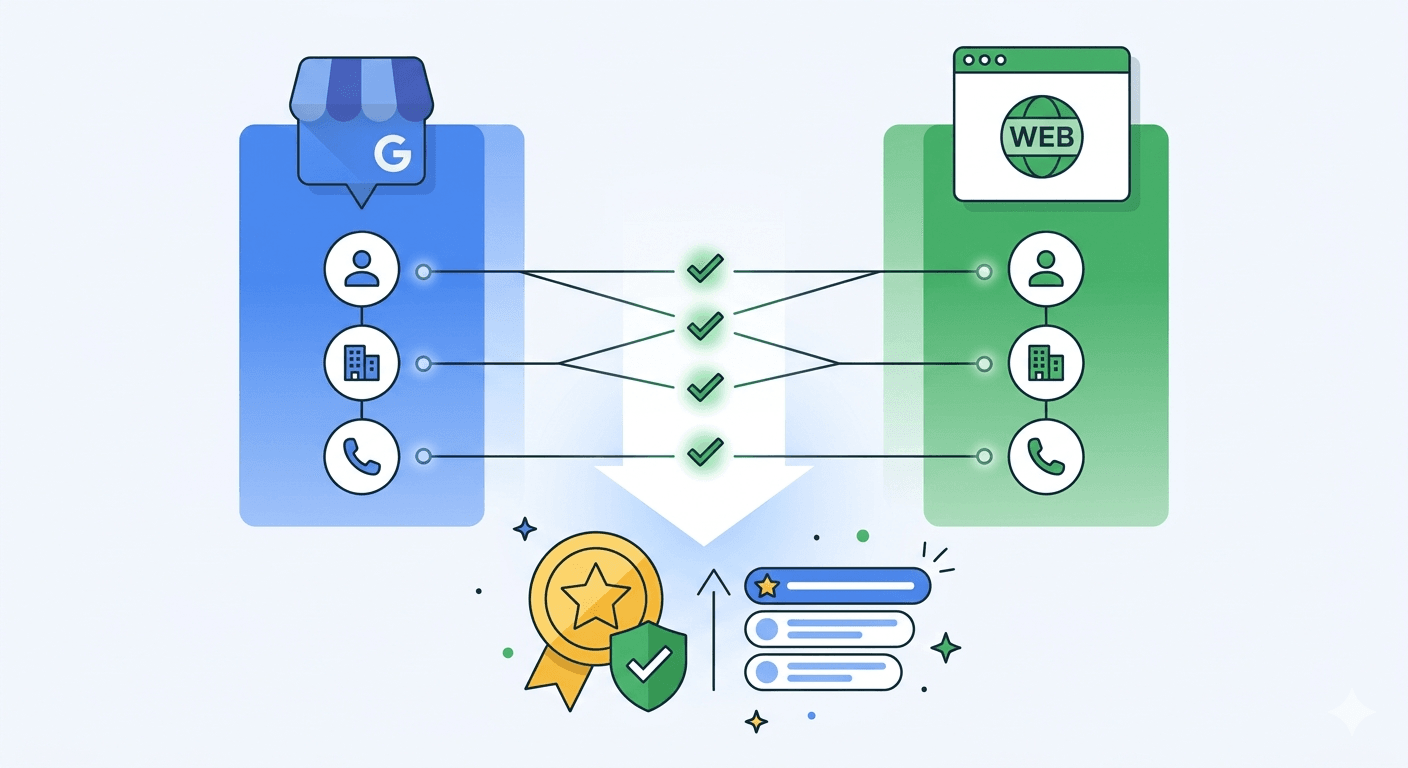
A website with local content (articles about services in a specific city, pages targeting specific neighbourhoods, local keywords) strengthens your listing's visibility in Google Maps. And conversely - an active listing with a high volume of reviews sends trust signals that help your website.
A useful rule of thumb: the listing attracts, the website converts.
Checklist: What to Do and in What Order
If you're starting from scratch, or you have one of these two but not the other, here's a concrete sequence:
Week 1-2: Google Business Profile
- Create or claim your Google Business Profile and verify it
- Fill in every field: category (as specific as possible), description, opening hours, photos (at least 10, your own, good quality)
- Make sure your NAP data matches exactly what's on your website (if you have one)
- Ask your first 5-10 customers for a review - this is the fastest signal you can send to the algorithm
Month 1-3: Website
- Minimum viable website: homepage with your offer, contact page with a map, about page
- Local keywords in headings and body content ("hairdresser Kraków", "haircut Podgórze")
- NAP data consistent with your Google listing
- SSL certificate (HTTPS) - without it, Google treats the site as unsecured and browsers warn visitors
Month 3+: Build and maintain
- Steady flow of reviews on your listing (ask every satisfied customer)
- Blog or articles section - at least one post per month
- Active listing management - posts, offer updates, replies to reviews
- Links from local directories and industry portals
What About Businesses With No Physical Address?
A common situation for freelancers, consultants, and remote-service businesses - including web agencies.
Google allows you to create a Business Profile without showing your address publicly. You define a service area instead (for example, "entire Poland" or specific regions). The trade-off: without a visible address in a specific city, your listing will appear mainly for branded searches (people who already know your name) rather than generic local queries like "web agency Kraków."
For this type of business, the website carries more weight than the listing. A strong organic presence, a blog that ranks for relevant industry phrases, and a well-built reputation online will do more for you than a listing without a fixed location.
Summary
A Google Business Profile and a website aren't alternatives - they're two components of the same strategy. The listing gives you local visibility and the first opportunity to make contact with a customer. The website gives them a reason to choose you over the competition.
In 2026, businesses that have only one of these two are losing ground to those who have both and look after both channels consistently.
The good news: the listing is free and you can optimise it today. A website is an investment that - done well - pays off for years.
Looking for a website that works together with your Google listing and generates clients through both? Get in touch - free quote, delivery from 2 weeks.
Related articles
Website for Electricians and Plumbers - How to Get More Jobs from Google
What should a trade website include? How to rank in Google Maps and win more jobs from search? A practical guide with specific steps for electricians and plumbers.

Will AI Replace Web Developers? What 2026 Data Shows
AI website builder or web agency - which do you actually need? Here's what 2026 data says about AI in web development and when it's worth hiring a professional.

Physiotherapy Website & SEO Guide: Get More Patients from Google
What does a physio clinic website actually need - and how do you rank on Google in 2026? A practical guide to SEO for physiotherapists.