Local SEO – how to rank your business in Google Maps
Learn how to effectively use local SEO to position your business in Google Maps. Practical tips and strategies to increase visibility.
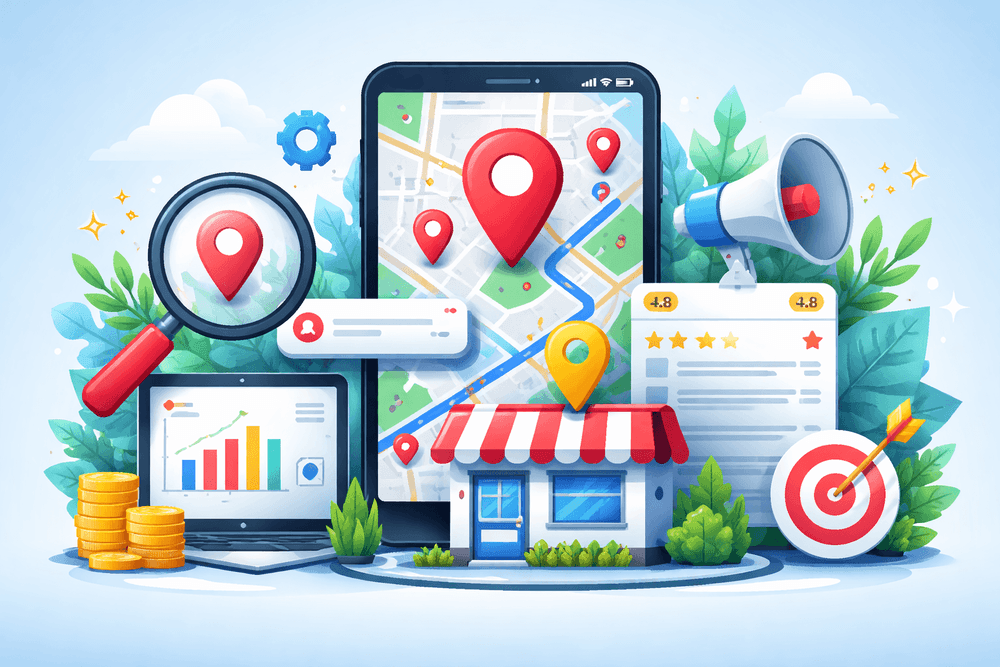
More and more customers are searching for local services and products online, and local SEO has become a key element of success for small and medium-sized businesses. According to research, over 80% of consumers use Google to find companies in their area. In this article, you will learn how to effectively position your business in Google Maps and increase visibility in local search results.
What is local SEO and why is it so important?
Local SEO is a set of optimization techniques aimed at increasing a company's visibility in search results for queries related to a specific location. When someone types into Google "hairdresser Warsaw" or "pizza near me," search engine algorithms prioritize local results.
For locally operating businesses such as restaurants, beauty salons, car repair shops, or medical offices, local SEO can generate up to 70% of all organic traffic to a website.
Key elements of local SEO
Local SEO consists of three main pillars:
- Google My Business profile - the foundation of all activities
- Local citations and directories - building credibility
- Website optimization - technical and content support
Google My Business - the foundation of local positioning
A Google My Business profile (now simply called a Google Business Profile) is the most important element of local SEO. A properly configured profile can significantly impact rankings in local search results.
Optimizing your Google My Business profile
Complete business information Fill in all available fields in your profile:
- Full business name (consistent with actual operations)
- Accurate address with postal code
- Phone number (preferably local)
- Opening hours (updated in real time)
- Business category (choose the most precise one)
High-quality photos Add at least 10-15 professional photos showing:
- Interior and exterior of the business
- Team at work
- Products or service results
- Company logo
Businesses with professional photos receive on average 42% more requests for directions and 35% more clicks to their website.
Case study: Restaurant "Smakolyki"
The "Smakolyki" restaurant from Kraków increased visits by 85% within 3 months thanks to Google My Business optimization. Key actions included:
- Adding the menu as high-resolution photos
- Regularly publishing posts about daily specials
- Actively responding to all reviews
- Updating opening hours during holidays
Result: growth from position 15 to 28 in local search results for gastronomy-related queries in Kraków.
Managing reviews and online reputation
Reviews are one of the most important ranking factors in local SEO. Google considers both the number of reviews and the average rating when determining positions in local results.
Review acquisition strategy
Actively encouraging customers
- Ask satisfied customers for feedback right after the service
- Send a follow-up email with a review link
- Place signs with QR codes in your location leading to your profile
Professional responses to reviews Respond to all reviews - both positive and negative:
- Thank customers for positive feedback
- Professionally resolve issues mentioned in negative reviews
- Show that you care about customer opinions
Case study: Hair salon "Nowe Oblicze"
A salon from Gdańsk implemented a systematic review management program:
- Created cards with a review link handed to clients
- Introduced SMS reminders for leaving reviews
- Responded to every review within 24 hours
Results after 6 months:
- Increase in reviews from 23 to 156
- Improvement in average rating from 4.2 to 4.7 stars
- 60% increase in new customers from Google Maps
Local citations and building credibility
Citations are mentions of a business online containing basic data: name, address, and phone number (NAP - Name, Address, Phone). Consistency of this data across all online sources is crucial for local SEO.
Most popular local directories in Poland
Nationwide directories:
- Pkt.pl
- Firmy.net
- Panorama Firm
- Moja Firma
- TuLokalne.pl
Industry-specific directories:
- For restaurants: Zomato, TripAdvisor, Gastronauci
- For hotels: Booking.com, Hotels.com, Trivago
- For medical services: KtoLEczy.pl, ZnajdzLekarza.pl
Principles of effective citation building
NAP consistency Make sure your business name, address, and phone number are identical across all sources. Even small differences (e.g., "St." vs "Street") can negatively affect rankings.
Quality over quantity It’s better to have 20 citations in reputable directories than 100 in questionable ones. Google values the authority of citation sources.
Website optimization for local SEO
Your website must be optimized for local queries and support your Google My Business efforts. How to create a website that sells is essential knowledge for local businesses.
Local keywords
Local keyword research In addition to main industry keywords, focus on phrases containing:
- District and neighborhood names
- Names of nearby cities
- Phrases like "near me", "close to"
- Local geographic terms
Examples of local keywords:
- "dentist Mokotów"
- "car mechanic Praga Południe"
- "restaurant near Centrum metro"
Optimizing local content
Dedicated location pages If you operate in multiple locations, create separate subpages for each:
- Unique content for each location
- Maps with directions
- Local information and insights
- Photos from the area
URL structure Use clear URLs containing location:
- good:
/services/warsaw/mokotow - bad:
/page-id-123
Mobile-first and page speed in local SEO
Most local searches (over 60%) are performed on mobile devices. Mobile optimization is not optional—it’s essential.
Key mobile-first elements
Responsive design Your site must look and function perfectly on all devices. Core Web Vitals are especially important for local SEO.
Fast loading
- Optimize image sizes
- Minimize plugins
- Use a CDN for faster content delivery
Easy contact
- Clickable phone numbers
- "Call now" buttons
- Integration with Google Maps
Case study: Car repair shop "AutoMax"
A workshop from Wrocław saw after mobile optimization:
- 45% increase in time spent on site
- 30% more phone calls from mobile devices
- Improvement in local rankings by an average of 8 positions
Key changes:
- Implementation of one-click call-to-action buttons
- Optimization of contact forms
- Adding a map with the exact workshop location
Measuring results and local SEO analytics
Without proper monitoring, it’s difficult to assess the effectiveness of local SEO efforts.
Key metrics to track
Google My Business Insights
- Profile views
- Customer actions (calls, website visits, direction requests)
- Search queries leading to the profile
- Photo views
Google Analytics
- Organic traffic from local keywords
- Conversions from local traffic
- Mobile user behavior
- Popular pages among local users
Search rankings Regularly check positions for key local phrases:
- Use rank tracking tools
- Check results from different locations
- Monitor local competitors
Common local SEO mistakes
Avoiding basic mistakes can significantly improve local SEO performance.
Google My Business mistakes
Incomplete information
- Missing business categories
- Outdated opening hours
- No business description
Ignoring reviews
- No responses to customer feedback
- Unprofessional reactions to criticism
- No system for acquiring new reviews
Technical website mistakes
Inconsistent NAP data Different versions of contact data across your site and directories can confuse Google algorithms.
Lack of mobile optimization Websites not optimized for mobile devices perform significantly worse in local search results.
The future of local SEO
Local SEO continues to evolve with technological advancements and changing consumer habits.
Trends for 2026
Voice search More people are using voice assistants to search for local businesses. Optimization for conversational queries is becoming crucial.
Artificial intelligence in search engines How Google’s role is changing in the AI era (SGE, AI Overviews, ChatGPT Search) shows how new technologies impact SEO. Local businesses must prepare for algorithm changes.
Hyper-localization Search engines are becoming increasingly precise in determining user location, meaning very local keywords are gaining importance.
Summary
Local SEO is a long-term strategy that requires consistent effort and patience. The keys to success are:
- Comprehensive approach - optimizing your Google My Business profile, website, and building citations
- Quality over quantity - fewer but higher-quality citations and reviews
- Continuous monitoring - regularly checking results and adjusting strategy
- Mobile-first - prioritizing mobile optimization
Remember that an effective website is the foundation of all local SEO efforts. Without a solid technical and content base, even the best Google My Business optimization will not deliver the expected results.
Local SEO takes time, but companies that consistently implement these techniques can expect a significant increase in visibility and customer numbers within just a few months of systematic work.
Related articles
Why Does My Competitor Rank Higher on Google Maps? 7 Reasons (and How to Fix Them)
Your competitor shows up in Google Maps and you don't? Here are 7 specific reasons why - and exactly what to do to fix each one.

The most common mistakes in website creation
The most common website design mistakes can seriously limit sales and Google visibility. Learn what to avoid when building a website, how to improve UX, SEO, and content, and how to create a site that truly supports your business goals.
Is SEO Still Worth It in 2026? (Honest Answer + What Actually Works)
SEO isn't dead — but it's changed. Here's what actually works in 2026: AI content, E-E-A-T, Core Web Vitals, and why organic traffic still beats paid ads long-term.