Why Does My Competitor Rank Higher on Google Maps? 7 Reasons (and How to Fix Them)
Your competitor shows up in Google Maps and you don't? Here are 7 specific reasons why - and exactly what to do to fix each one.
You type your industry and city into Google. Your business doesn't appear in the top three - or doesn't appear at all. Instead you see competitors whose services you know better than they do. It's frustrating. But in most cases, it has specific, fixable causes.
Why Google Maps Rankings Matter
Before we get into the reasons - one important fact: the block of three businesses in Google Maps (called the "local pack" or "map pack") appears above all organic search results. Research shows it captures around 42% of all clicks for local searches.
If you're not there, most potential customers will never reach your website. Not because you're worse. Because Google doesn't know enough about you.
7 Reasons Your Competitor Ranks Higher on Google Maps
1. Their Google Business Profile is complete - yours isn't
This is the number one ranking factor according to the Whitespark 2026 Local Search Ranking Factors report, compiled from 47 leading local SEO experts. Google Business Profile signals account for as much as 32% of the entire local ranking algorithm.
Look at your competitor's profile. They probably have:
- A filled-out services section with descriptions
- A complete list of attributes (parking, card payments, accessibility)
- Accurate opening hours including bank holidays
- Answers in the Q&A section
- Regular posts
Your profile probably has the basics - address, phone, maybe a few photos. That's not enough.
What to do: Log into business.google.com and fill out every available section. Literally every one. Google treats profile completeness as a trust signal.
2. They have the right primary category - you might not
Your primary category in Google Business Profile is, according to the Whitespark 2026 report, the single most important optimisation decision you can make for your listing. It determines which searches you're even eligible to appear in.
The problem is that many businesses choose a category that's too broad. Examples:
- "Restaurant" instead of "Italian Restaurant"
- "Hairdresser" instead of "Women's Hair Salon"
- "Physiotherapist" instead of "Sports Rehabilitation Clinic"
The more precisely your category describes your core offering, the stronger the relevance signal you send to Google.
What to do: Check what primary category your top competitor uses in Google Maps. If it's more specific than yours - change yours.
3. They have more reviews - and get them consistently
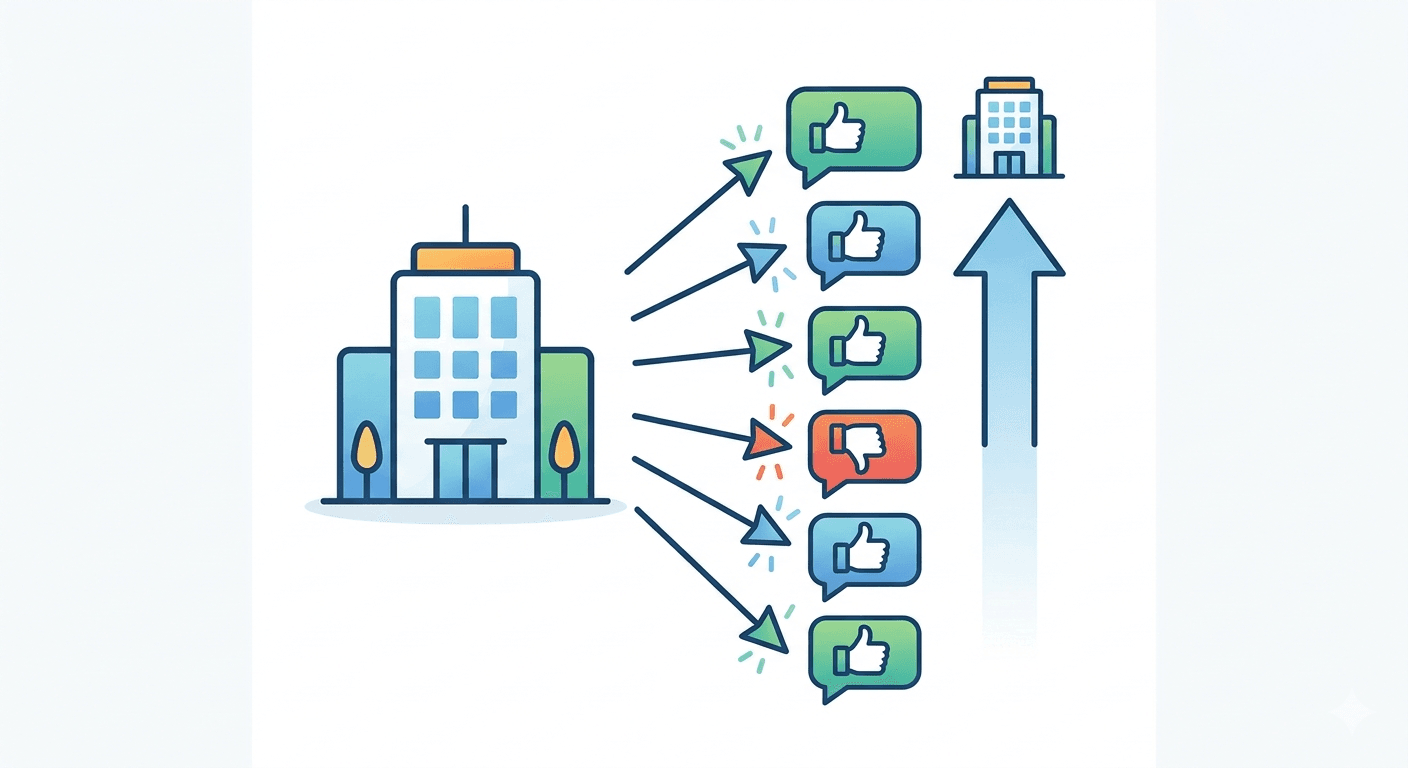
Reviews account for 16-20% of ranking power in Google Maps. And here's the trap most businesses fall into: they collect reviews once, then stop.
According to current data, Google rewards not just the quantity of reviews but their consistency. Two reviews per month is a stronger signal than 20 reviews earned in one month followed by silence for a year.
Research shows that businesses responding to 80% or more of reviews see a measurable ranking improvement. Every response - to positive and negative reviews alike - is an additional activity signal.
What to do: Build a simple system. After every completed service, send the customer a message with a direct link to your Google review form. Not once - consistently. And respond to every review.
4. They're closer to the centre - but that's not the whole story
Proximity is one of the three pillars of Google's local algorithm (relevance, distance, prominence). According to Whitespark 2026 research it accounts for roughly 55% of ranking decisions - and you have limited control over it.
You can't move your office to be closer to your customers. But you can minimise its impact by strengthening the other signals. Businesses with excellent reviews, complete profiles, and strong websites regularly outrank competitors who are physically closer to searchers.
What to do: Focus on the factors you can control - profile, reviews, website. You can also strengthen local presence through local directories and media mentions.
5. Their website supports their listing - yours doesn't
Google Maps rankings and search engine position are connected. Your website strengthens your listing through on-page signals: page titles, headings, content, and contact information.
Specifically - if your competitor's website includes the phrase "[service] [city]" in titles and headings, Google receives confirmation that this business genuinely operates in that location and provides those services. Your website without these signals weakens your listing instead of supporting it.
A separate problem: inconsistent NAP data (Name, Address, Phone number). If your website shows a different phone number than your Google listing, or an outdated address - Google loses confidence in your data and drops your position.
What to do: Make sure your business name, address, and phone number are identical on your website and in your Google listing. Literally identical - even "Street" vs "St." can matter.
6. They're mentioned elsewhere on the internet - you're not
Citations - mentions of your business on external websites like directories, industry portals, and local media - are a signal that tells Google: "this business exists, it's credible, others talk about it."
The Whitespark 2026 report indicates that citations are particularly important for visibility in AI-driven search (AI Overviews, ChatGPT). Businesses with a strong presence in directories and media appear more frequently in AI-generated answers.
What to do: Start with the basics - Yelp, Google, industry-specific directories in your field. Make sure your data is consistent everywhere.
7. They're active - you're not
Google treats Google Business Profile as a marketing channel, not a static entry in a phone book. Businesses that regularly:
- Add new photos
- Publish posts (offers, news, updates)
- Update opening hours before holidays
- Respond to Q&A questions
send Google a signal that they're active and engaged. That translates into higher positions.
Your profile might have two photos from 2022 and no post for several months. That's a dormancy signal for Google.
What to do: Set a reminder every two weeks - add one photo, one post, check that your hours are correct. You don't need hours of work - 15 minutes regularly is enough.
How Quickly Can You See Results?
An honest answer:
- Changing primary category: effects possible within a few days
- Completing the profile: 1-4 weeks
- Reviews: consistent flow over 2-3 months produces measurable results
- Website changes: 4-8 weeks for Google to index and reflect them
Local SEO isn't a one-time action - it's a system. Businesses that consistently maintain all these elements hold high positions long-term.
Frequently Asked Questions
Can I pay to rank higher on Google Maps? No - Google officially confirms that positions in organic Maps results are not for sale. You can pay for ads (labelled "Sponsored"), but organic results depend entirely on the quality of your signals.
Does star rating affect position? Yes, but not alone. Review consistency and actively responding to them have a greater impact than the rating itself. A business with 4.6 stars and 50 reviews often outranks one with 4.9 stars and 8 reviews.
I have a good profile but still rank low - why? The most common causes: inconsistent data between your website and listing, a primary category that's too broad, or strong local competition with a high volume of reviews. An audit of your profile is worth doing.
Is a website necessary to rank well in Maps? Not strictly necessary, but it significantly strengthens your position. Businesses without a website can appear in the local pack, but struggle in competitive industries.
The Bottom Line
Your competitor isn't ranking higher because they're better. They're ranking higher because they've taken better care of the signals Google considers. The good news: most of these signals are entirely within your control.
If you want to know exactly what's blocking your Google Maps position - book a free consultation. We'll review your profile and tell you what to change first.
Written by SN Solutions - we build websites and help local businesses be visible where their customers are already searching.
Related articles
Local SEO – how to rank your business in Google Maps
Learn how to effectively use local SEO to position your business in Google Maps. Practical tips and strategies to increase visibility.
The most common mistakes in website creation
The most common website design mistakes can seriously limit sales and Google visibility. Learn what to avoid when building a website, how to improve UX, SEO, and content, and how to create a site that truly supports your business goals.
Is SEO Still Worth It in 2026? (Honest Answer + What Actually Works)
SEO isn't dead — but it's changed. Here's what actually works in 2026: AI content, E-E-A-T, Core Web Vitals, and why organic traffic still beats paid ads long-term.